
Size and complexity
- The workforce of the NHS is one of the largest on earth: over 1.5 million people working in every healthcare setting, including hospitals, GP surgeries and pharmacies.
- Sir Robert Francis has spent many years steeped in the NHS, including chairing the Mid Staffordshire NHS Foundation Trust Public Inquiry. I am grateful to him for his authoritative and detailed two-part report produced for this Inquiry, which provides a comprehensive overview of the NHS.1 As many witnesses were later to say, and as Sir Robert Francis reminded the Inquiry at the outset, the NHS is not a single organisation. He described it as a “series of planets … which together provide a service and I use the word ‘together’ somewhat loosely”.2 The NHS was the subject of a large reorganisation in April 2013. The DHSC website hosted a diagram of the UK’s health and care system at that point (see Figure 6). As Sir Robert Francis observed, it placed patients at the centre of the diagram (a good thing) but the structure of the image exemplified the disconnected nature of the NHS: “[A]ll these bodies seem to go round in an orbit but none of them seem to be connected with each other.”3
Figure 6: The health and care system, April 2013
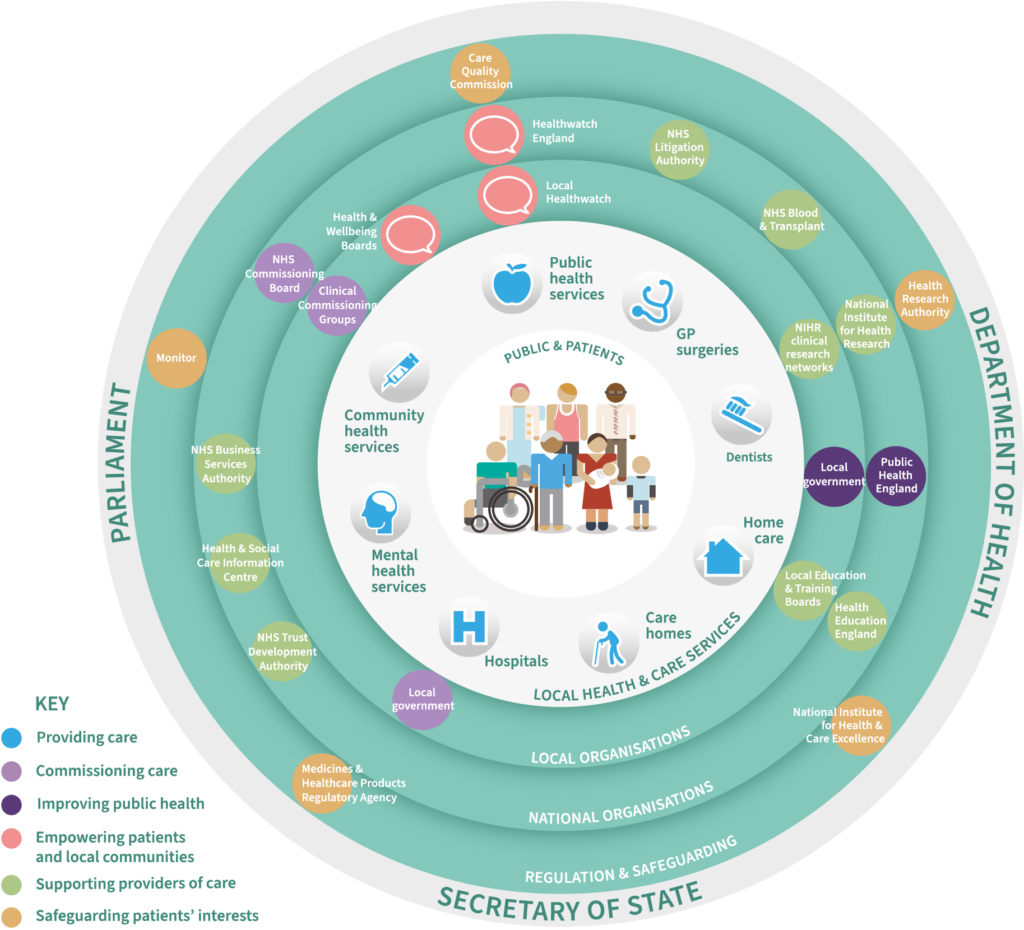
Source: INQ0101079/7
- Further reorganisations had taken place by the time of the Inquiry hearings in 2024 and 2025. In March 2025, it was announced that NHS England was to be abolished, with enormous ramifications for the workforce and for the running of the NHS. It goes without saying that changes in the administrative arrangements of the NHS must always be directed to improving patient care.
A common purpose?
- The NHS Constitution for England asserts that the NHS “belongs to the people” and that:
“It is there to improve our health and wellbeing, supporting us to keep mentally and physically well, to get better when we are ill and, when we cannot fully recover, to stay as well as we can to the end of our lives. It works at the limits of science – bringing the highest levels of human knowledge and skill to save lives and improve health. It touches our lives at times of basic human need, when care and compassion are what matter most.”4
- The constitution contains seven key principles:
- The NHS provides a comprehensive service, available to all.
- Access is based on clinical need, not an individual’s ability to pay.
- The NHS aspires to the highest standards of excellence and professionalism.
- The patient will be at the heart of everything the NHS does.
- The NHS works across organisational boundaries (i.e. with local authorities and other public sector and private sector organisations to provide and deliver improvements in health and well-being).
- The NHS is committed to providing best value for taxpayers’ money.
- The NHS is accountable to the public, communities and patients that it serves.
- There then follows a list of NHS values, developed with help from patients, the public and staff. The values “inspire passion in the NHS and … should underpin everything it does”.5
- The values are:
- Working together for patients
- Respect and dignity
- Commitment to quality of care
- Compassion
- Improving lives
- Everyone counts.
- The document explains that, with the national position having been set, individual organisations are expected to “develop and build upon these values, tailoring them to their local needs. The NHS values provide common ground for co-operation to achieve shared aspirations, at all levels of the NHS.”6
- I have looked at the statements of values of three NHS Foundation Trusts in different parts of England: University College London Hospitals, The Newcastle Upon Tyne Hospitals and Great Western Hospitals. All three have neonatal units. I also reviewed a further statement of values, from NHS England.
University College London Hospitals
- The short statement of vision and values reads: “Our mission is to deliver top-quality patient care, excellent education and world-class research.”7 The values are: safety, kindness, teamwork and improving. All four values are listed in the NHS Constitution.
The Newcastle Upon Tyne Hospitals
- The values are: care and kindness, high standards, inclusivity, innovation and pride. The last two are not listed in the NHS values but are not divergent from them.8
- This Trust has also identified (through consultation with over 1,000 of their staff) 8 ‘Big Signals’. These are described as “key issues to address”.9 They appear to be strategic goals. They are to:
- prioritise quality of care
- be a great place to work
- restore focus on excellence
- ensure technology supports patient care
- ensure buildings are fit for purpose
- take responsibility as a public service seriously
- develop our commitments to the communities who depend on us
- be open, honest and transparent about challenges and progress.10
Great Western Hospitals
- Great Western Hospitals’ Quality Strategy includes the vision to “deliver great joined up services for local people at home, in the community and in hospital, helping them to lead independent and healthier lives”.11
- There are also four pillars, which the Trust aims to be known for. These are: outstanding patient care with a focus on quality improvement; staff and volunteers feeling valued; improving the quality of patient care with partnerships; and using funding wisely.12
- There is further detail that aligns with values in the NHS Constitution.
NHS England
- NHS England’s statement of vision is “high quality healthcare for all”.13 The values listed are collaboration, inclusion, and learning and improvement. Again, these accord with the values stated in the NHS Constitution, despite some changes of language and the use of synonyms. NHS England also expressly endorses the NHS’s core values from the constitution and provides a link to that document.
- The values of the (very small sample of) three Trusts and NHS England are consistent with, if not identical to, those set out in the NHS Constitution. Whether the fact that the values in the constitution have not been replicated entirely by any of the organisations may indicate that some of the values are no longer considered relevant, I cannot say. This is something to be addressed when the constitution is reviewed after ten years, as required by section 3(3) of the Health Act 2009.14
- It is clear that the excellent local statements of values require significant time and effort to prepare. What is not clear is whether the quality of care is different (and better) than it would have been had the hospitals simply adopted the values set out in the NHS Constitution. The same applies to the NHS England document.
- At a time when the pressures on the whole workforce are enormous, I would suggest time (managerial, medical, nursing or other) should not be devoted to any task that does not improve patient care, or at least maintain it to a good standard. I suggest that the drafting of mission statements/values/vision statements should be given lower priority than tasks that have been shown to improve patient care.
Too many targets
- Hospitals are on the receiving end of a relentless flow of targets, directives, guidance and other documents from the centre – i.e. ministers, DHSC and NHS England. A number of witnesses expressed the view that there are too many targets. The Rt Hon. Jeremy Hunt MP, a former Secretary of State for Health, referred to “too many targets”, noting that “a Chief Executive of a hospital will be assessed against possibly 100 targets every year” and expressing the concern that this “crowds out the opportunity for longer term strategic changes”.15 General Sir Gordon Messenger also referred to the large number of targets, many being politically driven, noting that whilst some consider them “the stepping stone to better productivity”16 others take the view that there are too many targets and that when “everything is important, then nothing is important”.17 This is obviously correct. The Rt Hon. Professor the Lord Darzi of Denham OM KBE echoes these views in a 2024 report, observing: “As the Hewitt Review pointed out, there are too many targets set for the NHS which makes it hard for local systems to prioritise their actions or to be held properly accountable.”18
Too many regulators
- A number of witnesses, including Dr Benneyworth, Sir Robert Francis and Professor Dixon-Woods, referred to a 2019 paper in the British Medical Journal titled ‘Patient safety regulation in the NHS: Mapping the regulatory landscape of healthcare’.19 This found that there are “up to 126 organisations that exert regulatory influence” on NHS providers.20 That is an eye-catching number. Even for such a huge organisation as the NHS, it is unlikely that so many regulators are necessary. Dr Benneyworth put it more diplomatically: “[T]he message from [the paper] is absolutely clear in that we have a very complex expansive landscape for patient safety.”21 She thought it is important to think about the impact that all the organisations collectively have on local systems. She asserted local systems need to be empowered to deliver good care, and this might require the “rationalisation of organisations”.22 However, she also stated: “[S]omething we could do much quicker than [rationalisation] is about how we collaborate, how we work together, how we coordinate things much more formally across the system.”23 That is a commendable proposal and I support it. At the same time, the practical outcome of the abolition of NHS England should include a significant reduction in the number of regulatory bodies. To achieve that, an informed analysis of what they all do should be prepared then reviewed, and decisions taken about which bodies are necessary, which can be amalgamated and which can be abolished. Those that remain must be properly staffed.
- Dr Benneyworth pointed out that Dr Dash had again been commissioned by DHSC to conduct “a review into the patient safety landscape”.24 Dr Dash, who qualified as a doctor, took up the post of Chair of NHS England in July 2025, but until then she was for many years an independent management consultant who produced a number of reports for the NHS (see Chapters 40 and 42). On this occasion, she was asked to consider the functions and future roles of six organisations: CQC, HSSIB, the Office of the Patient Safety Commissioner, the National Guardian’s Office, Healthwatch England and Local Healthwatch, and the patient safety learning aspects of NHS Resolution.25 Dr Dash’s report was published in July 2025, shortly after she took up the post of Chair of NHS England.
- Notwithstanding the commission to review patient safety with particular reference to six organisations, Dr Dash stepped back and considered what she describes as “the overall quality of care”. This, she explains, includes safety, effectiveness and patient experience, as well as accessibility, equity and efficiency. Safety means “those who receive care are not harmed avoidably in the process”. Effectiveness means that “evidence-based care is provided to those who need it, while low-value care is minimised”. Positive patient or user experience means that “people have a good experience of care that is responsive to and respectful of their needs, values, preferences and cultural background”.26 Perhaps assessment of the outcome should be included in that definition.
- Strikingly, Dr Dash points out that there has been more focus – and therefore more funding – for safety, that is, more staff and more supervisors, particularly in hospitals. However, this has led, she says, to only a limited improvement in safety. Effectiveness and other aspects of the quality of care have received “relatively less attention or resource”.27 She advises that money should be spent where it will have the most impact and says there should be greater focus on community care with a view to improving health and so reducing the need for acute care. These are complex issues and I can see the judgements that need to be made when planning for a future where there is (hopefully) a reduced need for acute care compared with the position now, where safe care (e.g. in maternity wards) is not a given in many hospitals. Throughout the evidence to this Inquiry, from every expert and every witness, there was an acknowledgement of the fundamental importance of the safety of the patient. If spending money on safety has not achieved greater safety then scrutiny is required of what the money was spent on and to what purpose, with a view to directing resources, of all types, to the things that do work. Staying with the maternity example, there are very few NHS hospitals where maternity services are rated outstanding by CQC and about one-third where they are rated good. However, over 60% of hospitals are in neither of those categories and require improvement.28 As the recent reports of Baroness Amos LG CH and Ms Donna Ockenden make plain, a great deal of urgent work is needed to keep mothers and babies safe in hospital.
- CQC describes safety as their number one priority.29 At a time of real concern about certain areas of care (maternity care in particular), people need to know that is the case. Given the history of CQC (as I have set out in Chapter 7), I am not confident that the statement that safety is their number one priority will lead automatically to a situation where safety is a reality. A great deal of sustained improvement is necessary. There must be a rigorous and consistent review and assessment of the performance of CQC by the Health and Social Care Select Committee, initially once a year and, once the committee is satisfied, it should move to once every three years, or such other frequency as may be agreed between the NHS and the select committee.
- One of Dr Dash’s recommendations that has now been taken forward is the abolition of the National Guardian’s Office. I deal with this in Chapter 40.
Too many documents
- As is very well known and is clear from this Inquiry, many thousands of hours are spent across the NHS on administrative tasks that make no difference to the quality of patient care, including the production of lengthy documents of questionable value that there is no time to read.
- There is a multiplicity of guidance (clinical and non-clinical) which is sent out in large quantities. This is, I assume, essential for those carrying out clinical duties as they are expected to keep up to date with guidance as well as developments in their fields of practice. To that documentation may be added codes of conduct for medical and other professionals, reports and reviews (local and national), in addition to all the necessary documentation generated in the course of patient care. The fact that much of this is online disguises its volume. Everyone working in a hospital knows there is too much to read. A certain amount of documentation is required, of course, but a moment’s thought reveals the time spent in producing a document: it is typed, proofread (although not always), approved and uploaded to the internet. When such documents were printed, there was an inbuilt discipline to keep the length within reasonable bounds because of the cost of printing. The digital age means that documents can be as long as the writer wants them to be, with no concern for the reader.
Drafting by committee
- It is not unfair to observe that too many documents are drafted by committee. The effect of that is this: a dozen people (stakeholders) spend several hours over several months talking about what the document should contain. Then they draft it. It will be many pages long. To shorten it would take more of the committee’s time, so that rarely happens. Each hour saved by the committee leads to hundreds of hours spent by overstretched healthcare workers grappling with overlong and over complex documents. They are read ‘in their own time’ (i.e. outside of working and paid hours). It is an invisible subsidy of the NHS by its staff. Leaving aside the data centre requirements for the unrestricted production of documents to be distributed to thousands of people at the press of a button, information overload is real. The production of more documents than can be read is futile – and eye-wateringly extravagant of staff time.
- I shall look at some current documents later in Part Two.
- The focus in the reorganisation that is to result in the abolition of NHS England must be on identifying and then resourcing those tasks that will make a positive difference to the experience and outcomes of patients in hospital. Then there should be sufficient staff retained within the restructured DHSC/NHS England and in Trusts to deal with those tasks, and sufficient support staff for all those (nurses, doctors and non-clinical staff) who have managerial and leadership roles as well as their clinical roles. Health professionals with managerial roles in addition to clinical duties must be given protected time – not just within their job plan, but in reality.
Endnotes
1 Expert Report by Sir Robert Francis KC – Part 1 30 May 2024 INQ0101077; Expert Report by Sir Robert Francis KC – Part 2 30 May 2024 INQ0101079
4 DHSC, The NHS Constitution for England, 17 August 2023 (https://www.gov.uk/government/publications/the-nhs-constitution-for-england/the-nhs-constitution-for-england)
5 DHSC, The NHS Constitution for England, 17 August 2023 (https://www.gov.uk/government/publications/the-nhs-constitution-for-england/the-nhs-constitution-for-england)
6 DHSC, The NHS Constitution for England, 17 August 2023 (https://www.gov.uk/government/publications/the-nhs-constitution-for-england/the-nhs-constitution-for-england)
7 University College London Hospitals NHS Foundation Trust, ‘About us’ (https://www.uclh.nhs.uk/about-us)
8 The Newcastle upon Tyne Hospitals NHS Foundation Trust and Group, Annual Report and Accounts 2024/25, page 9 (https://www.newcastle-hospitals.nhs.uk/wp-content/uploads/2025/07/The-Newcastle-upon-Tyne-NHS-Foundation-Trust-Annual-Report-and-Accounts-2024-25-FINAL.pdf#page=9)
9 The Newcastle upon Tyne Hospitals NHS Foundation Trust and Group, Annual Report and Accounts 2024/25, page 9 (https://www.newcastle-hospitals.nhs.uk/wp-content/uploads/2025/07/The-Newcastle-upon-Tyne-NHS-Foundation-Trust-Annual-Report-and-Accounts-2024-25-FINAL.pdf#page=9)
10 The Newcastle upon Tyne Hospitals NHS Foundation Trust and Group, Annual Report and Accounts 2024/25, page 61 (https://www.newcastle-hospitals.nhs.uk/wp-content/uploads/2025/07/The-Newcastle-upon-Tyne-NHS-Foundation-Trust-Annual-Report-and-Accounts-2024-25-FINAL.pdf#page=61)
11 Great Western Hospitals NHS Foundation Trust, Quality Strategy 2022–2026, page 2
(https://www.gwh.nhs.uk/media/wsuh2yrq/quality-strategy-2022-26.pdf#page=2)12 Great Western Hospitals NHS Foundation Trust, Quality Strategy 2022–2026, page 2
(https://www.gwh.nhs.uk/media/wsuh2yrq/quality-strategy-2022-26.pdf#page=2)13 NHS England, ‘What we do’ (https://www.england.nhs.uk/about/what-we-do/#:~:text=Our%20mission,population%20and%20the%20wider%20economy.)
14 Health Act 2009, section 3(3) (https://www.legislation.gov.uk/ukpga/2009/21/section/3)
18 The Rt Hon. Professor the Lord Darzi of Denham OM KBE, Independent Investigation of the National Health Service in England, September 2024, page 126, para 31 (https://assets.publishing.service.gov.uk/media/6a05a27e97000cb6073e4dd8/lord-darzi-independent-investigation-of-the-national-health-service-in-england-updated-14-May-2026.pdf#page=130)
19 Eirini Oikonomou, Jane Carthey, Carl Macrae and Charles Vincent, ‘Patient safety regulation in the NHS: Mapping the regulatory landscape of healthcare’, British Medical Journal, 9:7 (2019) (https://bmjopen.bmj.com/content/9/7/e028663)
25 Dr Penny Dash, Review of Patient Safety Across the Health and Care Landscape, DHSC, 7 July 2025 (https://www.gov.uk/government/publications/review-of-patient-safety-across-the-health-and-care-landscape/review-of-patient-safety-across-the-health-and-care-landscape#introduction)
26 Dr Penny Dash, Review of Patient Safety Across the Health and Care Landscape, DHSC, 7 July 2025 (https://www.gov.uk/government/publications/review-of-patient-safety-across-the-health-and-care-landscape/review-of-patient-safety-across-the-health-and-care-landscape#appendix-2-definition-and-impact-of-quality-including-safety-of-care)
27 Dr Penny Dash, Review of Patient Safety Across the Health and Care Landscape, DHSC, 7 July 2025 (https://www.gov.uk/government/publications/review-of-patient-safety-across-the-health-and-care-landscape/review-of-patient-safety-across-the-health-and-care-landscape#findings-of-the-review)
28 CQC, ‘The state of health care and adult social care in England 2024/25: Focus on maternity’, 24 October 2025 (https://www.cqc.org.uk/publications/major-report/state-care/2024-2025/focus/maternity)
29 CQC, ‘Assessment framework: Safe’, 22 February 2024 (https://www.cqc.org.uk/guidance-regulation/providers/assessment/single-assessment-framework/safe)