
Lady Justice Thirlwall has today published her report into the failings by all those responsible for the safety of babies at the Countess of Chester hospital.
The report calls for urgent changes to protect babies as Chair says, “this must never happen again.”
Lady Justice Thirlwall pays tribute to the dignity and courage of the parents and thanks them for sharing their experiences with the Inquiry.
The report finds that the collapse and deaths of some babies could have been avoided had safeguarding practices been followed.
Delivering her report Lady Justice Thirlwall, said:
“My Report describes dysfunctional management and governance; a gulf between hospital leadership and clinicians; and failure to understand the fundamentals of safeguarding.
“There was a complete failure to protect babies on the neonatal unit at the Countess of Chester Hospital. This was because no-one seems to have understood that safeguarding action is required when a member of staff is suspected of causing deliberate harm and does not require colleagues to be sure of guilt.”
The Inquiry would like to remind everyone commenting on the Report, that the parents have suffered grievously and continue to suffer as a result of the unexpected collapses and in some cases deaths of their babies, and all that has followed in the 10 or 11 years since then. Their dignity and courage should be respected by everyone.
The Report finds that senior nurses never accepted that the consultants’ concerns were – or might be – justified, and that there was a prolonged delay by senior managers in calling the police.
The inquiry Report is critical of successive internal and external reviews commissioned by hospital leadership after concerns were raised about Letby. The reviews did not address whether deliberate harm was being caused or not. In particular, and as the Royal College of Paediatrics and Child Health accepted, the service review it carried out could not and did not address the doctors’ concerns and should never have been undertaken.
Rather than being believed when concerns were raised, clinicians were themselves made the subject of investigation within Letby’s grievance process. Three consultants were told to apologise to Letby, and plans were formulated (although later abandoned) to bring Letby back onto the neonatal unit.
The Report reflects the anger some parents feel at the way they were treated by the Hospital which was palpable during the Inquiry hearings. They were kept in the dark for years about what was happening and about the fact that there were concerns that their babies may have been deliberately harmed. Their consent was not obtained before sharing their babies’ medical records with external experts and other organisations; they were not informed about reviews; and only in 2018 did they learn that the collapses and deaths may have been the result of the actions of a nurse in whom they had put their trust.
Many parents took the view that protecting the reputation of the hospital was more important to senior managers than keeping them informed about what was happening. The lack of consideration shown to the parents at that time was reprehensible.
The Report concludes by recommending a series of urgent reforms to practices in the operation and supervision of NHS neonatal units.
The Hospital’s safeguarding policy did not mention the possibility of deliberate harm by a staff member, and to this day there is still no NHS-wide protocol on deliberate harm.
Schools and social care providers have already accepted the possibility of malicious actions and know how to manage concerns. The NHS must follow, and adopt a suspicion of deliberate harm protocol, so that managers can no longer refuse to investigate when concerns are raised.
It is clear that some babies would have been saved and some attacks would have been prevented if action was taken earlier.
The full list of 17 recommendations can be found at chapter 45 of the report, they include:
- All cots and incubators in all neonatal units should be fitted with baby monitors (in-cot cameras with livestreaming video), so that parents can observe their baby remotely at any time. This will deter someone who wants to harm a baby and parents will be reassured to be able to see their babies when they cannot be with them.
- Until access to insulin storage is controlled by biometric data, each Trust should install CCTV cameras directed to fridges or other units storing insulin.
- By 31 March 2027, all hospital Trusts must have in place effective mechanisms for Board-level monitoring of all deaths of children and babies, with a clear route to the Board for the escalation of concerning data trends or patterns.
Notes to editors:
For media enquiries please contact media.enquiries@thirlwallinquiry.co.uk
About the Inquiry:
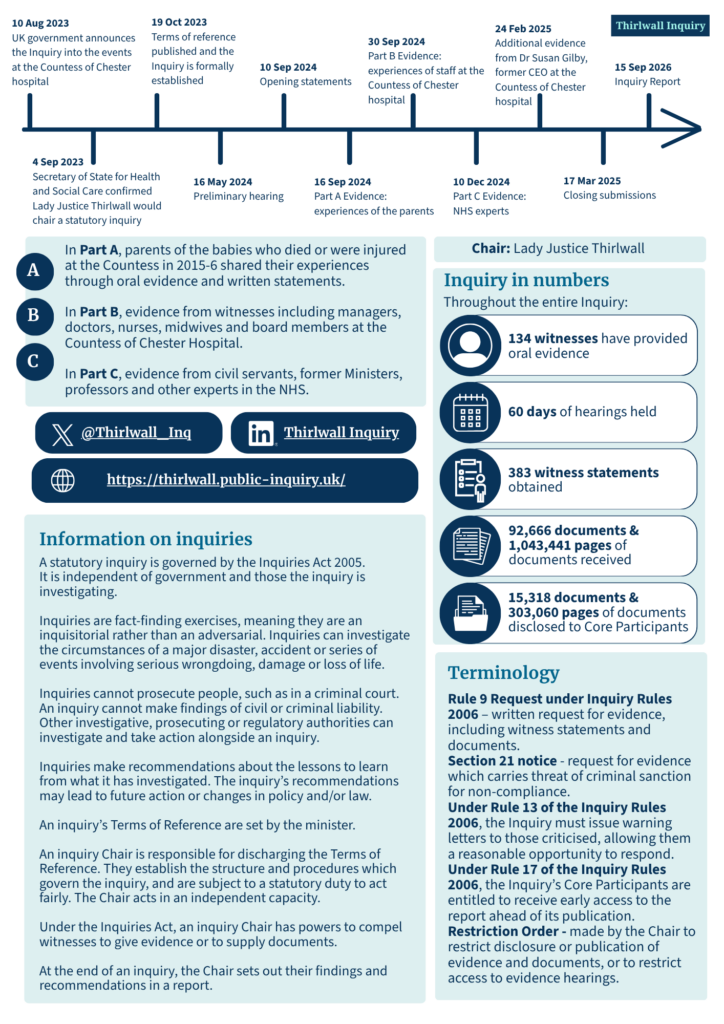
- The Thirlwall Inquiry was established to examine the events at the Countess of Chester Hospital and the implications of those events. It investigated the experiences of the families of all the babies named on the original indictment; the conduct of those working at the hospital, including the board, managers, doctors, nurses and midwives; and effectiveness of NHS management and governance structures and processes, external scrutiny and professional regulation in keeping babies in hospital safe.
- Over the course of the Inquiry, the Chair issued rulings on Livestreaming; a media broadcast protocol for evidence hearings; the core participant determination of Letby; and an application to pause the Inquiry.
- Restriction Orders:Reporting Restriction Orders made in the Crown Court under ss.45 and 46 of the Youth Justice & Criminal Evidence Act 1999 continue to apply, which means that matters which identify or are likely to identify certain individuals cannot be published. This includes the identity of babies named on the indictment, their parents and a small number of medical professionals who gave evidence in the criminal trial. The Inquiry and those reporting on the Inquiry are bound by these orders.
- A further excepting direction order was made on 17 October 2024 by Goss J to amend the s.46 Youth Justice & Criminal Evidence Act 1999 reporting restrictions order, dated 7 October 2022, put in place during the criminal trial in respect of Nurse W. The amendment reads as follows: “it shall not be prohibited for the Thirlwall Inquiry to publish the transcript, or reference in any report or other Inquiry publication, of the evidence given to it by Nurse W on 14 October 2024 to the extent that it does, or may, reveal the current location of Nurse W’s place of work. Save for these exceptions, the general prohibition on identifying any current place of work as being the current place of work by any witness remains in force.”
Copies of the reporting restrictions are available to accredited media from the Judicial Press Office.
A separate restriction in respect of Dr U (Dr Deakin) was lifted on 2 September 2026, after his death and after the report had been written. For this reason, the cipher appears throughout the report.
In addition, the media should be aware of restriction orders made by Lady Justice Thirlwall:
- Lady Justice Thirlwall has made a Restriction Order, updated 13 September 2024 to give effect to how she will hear evidence in Part A of the Inquiry, given by the parents of the children named on the indictment. A copy of this is attached.